

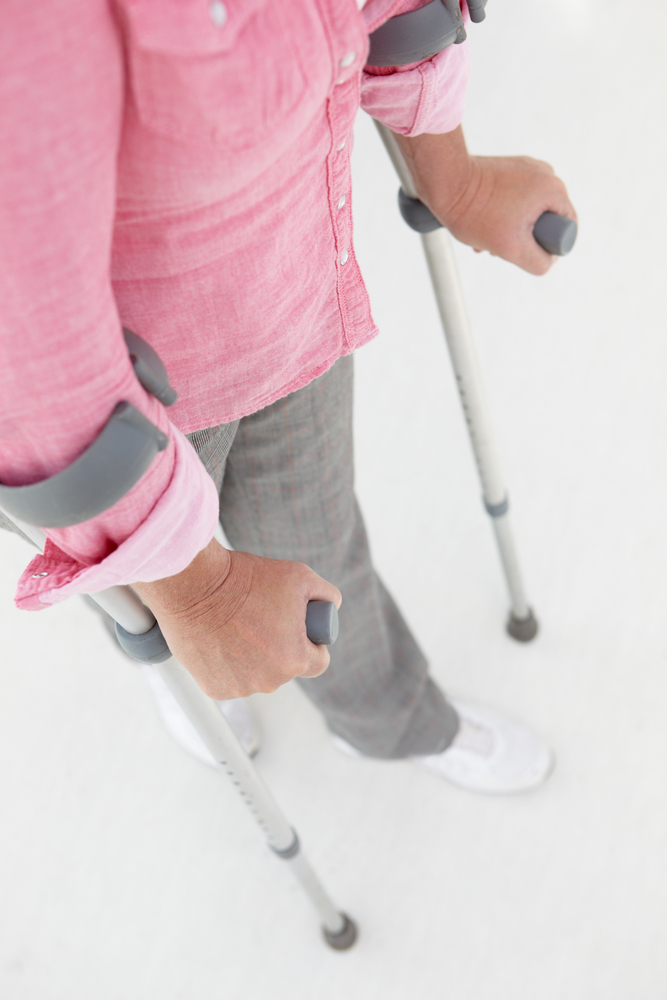
When do you need to use crutches?
After surgery on the lower limb if the surgeon’s protocols require non weight bearing (NWB) or partial weight bearing (PWB).
If you have an undisplaced fracture in the fibula or foot that doesn’t require surgery to place screws or plates, called open reduction and internal fixation (ORIF). You will usually be given a moon boot to stabilize and protect your lower leg and crutches are needed to be able to use this. Usually NWB initially and then PWB as the fractures heal.
If you do require open reduction and internal fixation ORIF for a lower limb fracture, the good news is, depending on the surgeon’s protocol, you can often PWB once it is tolerated, using crutches. Research has shown that your overall recovery is faster with PWB and the healing of the fracture is not usually impaired by PWB. Some research has also shown that FWB is no worse for fracture recovery compared to PWB after ORIF.
If you wan’t walk without a marked limp with a lower back, hip, knee or lower leg injury.If you need crutches or not is best assessed by a physiotherapist. If possible, it is best to stay off crutches but if you are limping badly or the pain is too extreme, crutches may be recommended. Otherwise, you may develop pain and dysfunction in other areas of your lower limb which could have been avoided by using crutches. Don’t use crutches for minor things. It can be difficult to get back off the crutches. If you do need crutches and you have an appointment at e-physiotherapy, crutches are loaned without charge.
If you have balance issues, you might need to use crutches (or a stick). The goal is to improve your balance with balance exercises and strengthening so that you can get back off the crutches when possible. In the mean time, for safety and to help prevent falls, it can be best to use crutches (or a stick). it is important to remember that your balance won’t improve, and may get worse if using crutches for balance issues and you don’t do balance and strengthening exercises. Your need for crutches is best assessed by a physiotherapist, who is an expert in deciding who needs walking aids due to balance issues.
Which crutches are best, elbow crutches or axillary (under arm) crutches?
Generally elbow crutches are best, unless you need extra support from axillary crutches. The issue with axillary crutches is that they can put pressure on the brachial plexus (a web of nerves in the arm pit). This can cause nerve injuries and weakness in the arms if the crutches are too high. This is called crutch palsy and it can take many weeks to recover from. A two finger gap between your arm pit and the top of the crutch helps avoid nerve injury. Elbow crutches are also easier to use and do other things with your hands as you can hang them from your forearm when you are not walking with them. Either crutch can lead to wrist pain as you are taking your body weight through your hands and wrists. As you put less weight through your hands as you progress from FWB to PWB it is less likely to be a problem.
At what height should your crutches be?
Crutch handle height should be at the height of your wrist crease with your arm hanging down relaxed.
How do you walk on stairs with crutches?
Stairs, – good leg to heaven, bad leg to hell. The crutches stay with your affected leg to provide it with support.
Step to and step through gait with crutches.
When you are walking, keep your crutches with the problem leg or place then down just before you put any weight though the affected limb. The goal is to reduce load on that leg, so keeping the crutches with the problem leg is essential.
Step though gait with crutches is a more natural way to use crutches than a step to gait. Step through gait simply means that you bring your unaffected leg forward, past the crutches when walking. Step to gait you simply bring your unaffected leg forward to the crutch position. Using the step through gait makes it easier when you are coming off crutches as you are already walking with a normal step length. If you have more pain or are just starting to PWB with crutches, you may start with a step to gait as it is more stable. Try to step through as soon as it isn’t too painful to do so.
Three point walking with crutches. Sometimes for more support, the tree point gait is needed with crutches. This is a bit more complicated that the step to and step through gaits and is not used that often except for immediately post surgery in hospital. There are many videos of walking with the different gaits if you need to use three point gait.
When you are still recovering from your injury and you may have some continuing weakness, balance issues or pain, you may feel the need to keep using crutches when you are in busy or crowded spaces for a short period longer than necessary to make other people aware that you have an injury so they will (hopefully) make space for you or let you sit on the bus.
If you need an assessment for using crutches or other mobility assistance devices, please book an appointment at e-physiotherapy. Crutches are loaned for short periods for free if you have booked a physiotherapy appointment at e-physiotherapy and require crutches when assessed by the physiotherapist.
References:
Li Y, Xie L, Li W. Effect of early partial weight-bearing rehabilitative exercise on postoperative functional recovery of sanders IV calcaneal fractures. Am J Transl Res. 2021 Jul 15;13(7):8316-8322. PMID: 34377322; PMCID: PMC8340153.
Paulsson M, Ekholm C, Jonsson E, Geijer M, Rolfson O. Immediate Full Weight-Bearing Versus Partial Weight-Bearing After Plate Fixation of Distal Femur Fractures in Elderly Patients. A Randomized Controlled Trial. Geriatr Orthop Surg Rehabil. 2021 Dec 6;12:21514593211055889. doi: 10.1177/21514593211055889. PMID: 35145761; PMCID: PMC8822340.




Leave A Comment