

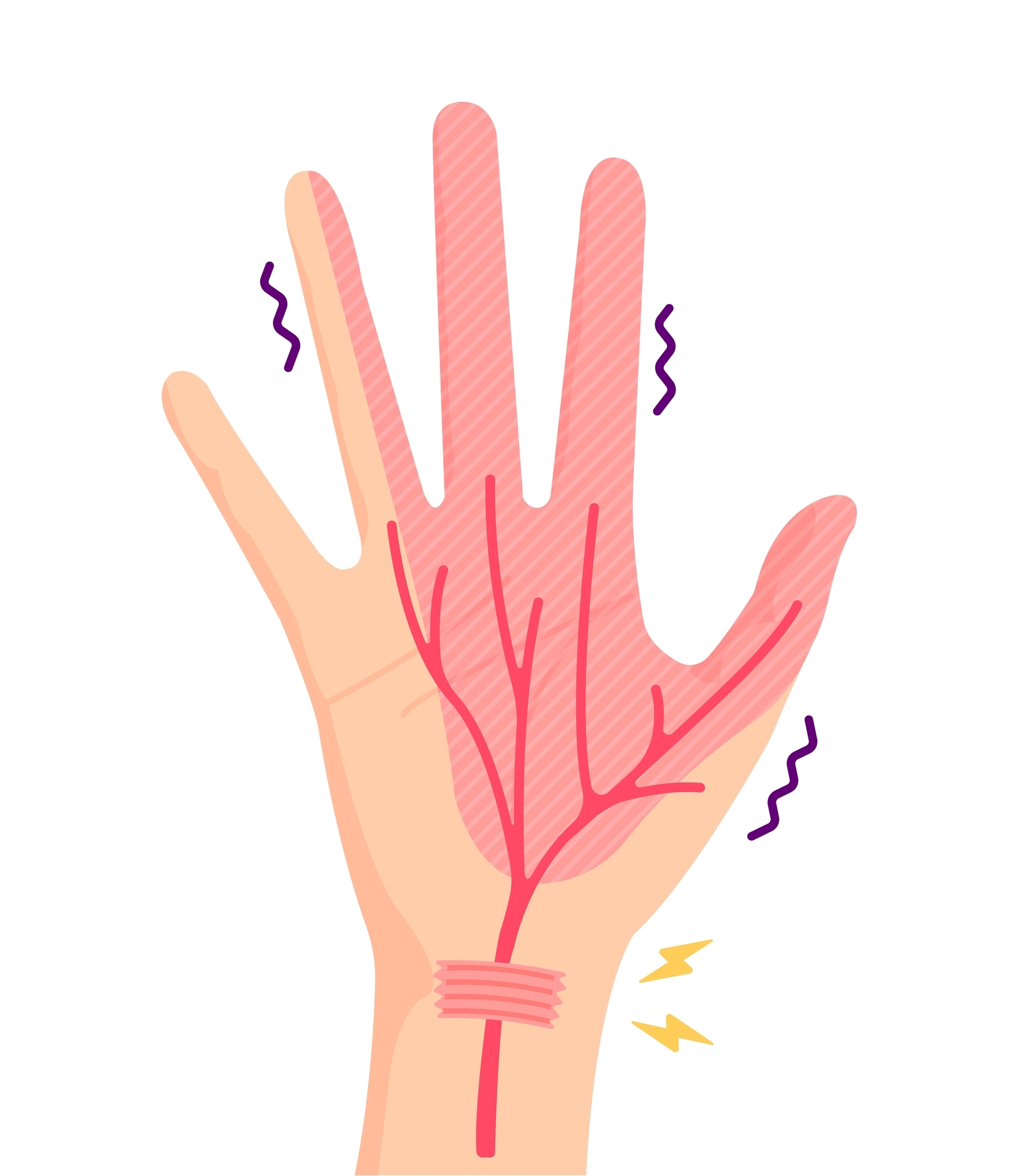
What is carpal tunnel syndrome? Carpal tunnel syndrome occurs when the median nerve, which is in the centre of the palmar side of your wrist, is compressed as it passes through the carpal tunnel. The carpal tunnel is the area between the two rows of small bones in the wrist, called carpal bones, and the flexor retinaculum, which is a thickened ligament on the palmar wrist. The flexor retinaculum is designed to keep the median nerve and adjacent tendons in place as they pass through the wrist. When this space is narrowed by swelling and inflammation or from changes to the available space in the carpal tunnel, as may happen after trauma or repeated micro-trauma such as overuse, carpal tunnel symptoms may develop.
What are the signs and symptoms of carpal tunnel syndrome? Usually the initial and main symptom of carpal tunnel syndrome is paraesthesia (pins and needles and/or numbness) in the area that the median nerve innervates in your hand. That is the palmar side of the thumb, index, middle finger, and the adjacent half of the ring finger. There can be some paraesthesia of the tips of the fingers on the back of the hand, but not the dorsal hand. Once carpal tunnel syndrome has been present for longer, it can also lead to weakness and muscle atrophy (reduced muscle size). This is most notable in the thenar eminance of the thumb, which is made up of the abductor pollicis brevis, flexor pollicis brevis, and opponens pollicis. There is also median nerve innervation of the lumbricals on the thumb side of the hand, but as these are deeper in the hand, the atropy of these muscles is not as visible. However, weakness of these muscles can be measured by testing pincer grip (gripping between the thumb and index finger).
Are some people more prone to carpal tunnel syndrome? There are many causes of carpal tunnel syndrome. It can happen spontaneously, after trauma/fractures of the carpal bones, with inter-carpal bone ligament injuries, with degenerative changes in the carpal bones, with inflammatory conditions like rheumatoid arthritis, during pregnancy or menopause, from using equipment that vibrates, and with repeated gripping or flexion and extension of the wrist. Some people have genetically smaller carpal tunnels and can be more prone to developing carpal tunnel syndrome.
What is referred cervical spine (neck) pain? Pain can be referred from you cervical spine to the arm and hand as the nerve roots from the cervical spine innervate the upper limb. If the facet joints (the bony joints between vertebrae) are inflammed or stiff, they can refer pain into your arm. Usually the pain will be felt along the arm rather than in the hand alone (as in carpal tunnel syndrome) If there is compression of the cervical spine nerve roots, from degeneration, disc protrusions or joint stiffness, the referred pain may include paraesthesias, the same as occurs with carpal tunnel syndrome. This can make it difficult to differentiate if the symptoms are from the cervical spine or carpal tunnel, or both.
What levels of the cervical spine innervate the wrist and hand? Cervical spine levels C6, C7 and C8 innervate the wrist and hand. What cervical nerve roots combine to make up the median nerve? Cervical spine nerve roots C6, C7, C8 and throacic spine T1.
What nerves innervate which parts of the hand? The median nerve innervates the palmar side of the thumb, index, middle finger, and the adjacent half of the ring finger. There is also some innervation of the tips of the fingers on the back of the hand, but it does not innervate the dorsal hand, that is innervated by the radial nerve on the thumb side of the hand. It also does not innervate the little finger side of the hand and fingers, this is innervated by the ulnar nerve. So, if you have paraesthesia in the back of your hand or the little finger side of the hand, you do not have a median nerve injury or carpal tunnel syndrom but an injury of the radial or ulnar nerve, or a cervical nerve root from C6, C7 or C8.
Differentiating carpal tunnel symptoms from cervical nerve root symptoms. The C6 nerve root innervates both the palmar side and dorsal side of the thumb, the median nerve only innervates the palmar side of the thumb. The C7 nerve root innervates both the palmar and dorsal side of the index and middle fingers. The median nerve only innervates the palmar side of these fingers and a small part of the dorsal finger tips. Innervation of the ring finger varies quite a lot between individuals, so isn’t as useful for determining if you have carpal tunnel syndrome or a cervical spine nerve root injury of C6 or 7.
The C8 and T1 levels of the median nerve are not so much for sensation but for muscle innervation of the small thumb muscles in what is called the thenar eminance. These muscles are the abductor pollicis brevis, flexor pollicis brevis, and opponens pollicis. If these muscles are atrophied, but other muscles that are innervated by C8 and T1 are normal, it suggests that the median nerve is being compressed in the carpal tunnel of the wrist. Examples of muscles innervated by C8 and T1 are wrist flexor muscles and finger flexors. So if wrist flexion and grip are normal but there are atrophied and weak thenar eminance (thumb) muscles, it is likely median nerve compression in the carpal tunnel is the cause of the weakness. Similarly, if there is weakness of the pincer grip, it suggests compression of the median nerve in the carpal tunnel.
Tests for carpal tunnel syndrome or referred cervical spine pain and paraesthesia.
The reliability, sensitivity, and specificity of manual tests (such as Phalen’s, reverse Phalen’s, Tinel, Durkan’s and Phdurkan’s tests) for carpal tunnel are not consistent, so they need to be use in conjunction with a history of the symptoms. The upper limb tension test (ULTT) is much more sensitive but is not specific. This means that if the ULTT is negative, it strongly suggests that the symptoms are not being caused by a cervical nerve root injury. If the ULTT is positive, it can suggest either cervical nerve root involvement or carpal tunnel syndrome, it doesn’t help to differentiate between them.
Imaging with MRI and nerve conduction studies are the most reliable way to diagnoise carpal tunnel syndrome and/or referred neck pain, but remember that the imaging needs to fit with the symptoms to be relevant. There might be degeneration in the cervical spine but it might not be referring symptoms to your hand. Also, if the cervical spine levels showing degeneration or disc protrusions do not fit with the area of pain and paraesthesia in your hand, it is unlikely causing those symptoms.
If manual therapy on the cervical spine improves symptoms in the hand, it suggests the cervical spine is causing the symptoms. However, carpal tunnel syndrome can cause tension in the cervical spine and partial relief of symptoms may not help with differential diagnosis.
it is possible to have both cervical spine nerve root involvement and carpal tunnel syndrome at the same time.
Treatment for carpal tunnel and/or referred neck pain. Physiotherapy manual therapy on the carpal bones, flexor retinaculum, nerve path neurodynamics and cervical spine may improve symptoms but there is limited research evidence to support this. There is also limited research evidence that ultrasound therapy and acupuncture/dry needling, can help reduce swelling and carpal tunnel symptoms.
Using a wrist support that keeps the wrist in a neutral position, especially at night, can help to control carpal tunnel syndrome symptoms. Research evidence for this is also limited. Corticosteroid injections for carpal tunnel may provide relief for up to six weeks but the research evidence for this is limited.
Surgery is often needed in more severe cases. The success rate of surgery is still debatable. A Cochrane review of the research evidence suggests surgery may have slightly better long term outcomes than physiotherapy, manual therapy, and splints.
References
Choi GH, Wieland LS, Lee H, Sim H, Lee MS, Shin BC. Acupuncture and related interventions for the treatment of symptoms associated with carpal tunnel syndrome. Cochrane Database Syst Rev. 2018 Dec 2;12(12):CD011215. doi: 10.1002/14651858.CD011215.pub2. PMID: 30521680; PMCID: PMC6361189.
InformedHealth.org [Internet]. Cologne, Germany: Institute for Quality and Efficiency in Health Care (IQWiG); 2006-. Carpal tunnel syndrome: Learn More – How effective are steroids? [Updated 2024 Dec 17]. Available from: https://www.ncbi.nlm.nih.gov/books/NBK279598/
Karjalainen TV, Lusa V, Page MJ, O’Connor D, Massy-Westropp N, Peters SE. Splinting for carpal tunnel syndrome. Cochrane Database Syst Rev. 2023 Feb 27;2(2):CD010003. doi: 10.1002/14651858.CD010003.pub2. PMID: 36848651; PMCID: PMC9969978.
Khosrawi S, Moghtaderi A, Haghighat S. Acupuncture in treatment of carpal tunnel syndrome: A randomized controlled trial study. J Res Med Sci. 2012 Jan;17(1):1-7. PMID: 23248650; PMCID: PMC3523426.
Lusa V, Karjalainen TV, Pääkkönen M, Rajamäki TJ, Jaatinen K. Surgical versus non-surgical treatment for carpal tunnel syndrome. Cochrane Database Syst Rev. 2024 Jan 8;1(1):CD001552. doi: 10.1002/14651858.CD001552.pub3. PMID: 38189479; PMCID: PMC10772978.
Page MJ, O’Connor D, Pitt V, Massy-Westropp N. Therapeutic ultrasound for carpal tunnel syndrome. Cochrane Database Syst Rev. 2013 Mar 28;2013(3):CD009601. doi: 10.1002/14651858.CD009601.pub2. PMID: 23543580; PMCID: PMC7100871.
Page MJ, O’Connor D, Pitt V, Massy-Westropp N. Exercise and mobilisation interventions for carpal tunnel syndrome. Cochrane Database Syst Rev. 2012 Jun 13;2012(6):CD009899. doi: 10.1002/14651858.CD009899. PMID: 22696387; PMCID: PMC11536321.
Zhang D, Chruscielski CM, Blazar P, Earp BE. Accuracy of Provocative Tests for Carpal Tunnel Syndrome. J Hand Surg Glob Online. 2020 Apr 21;2(3):121-125. doi: 10.1016/j.jhsg.2020.03.002. PMID: 35415497; PMCID: PMC8991863.



Leave A Comment