

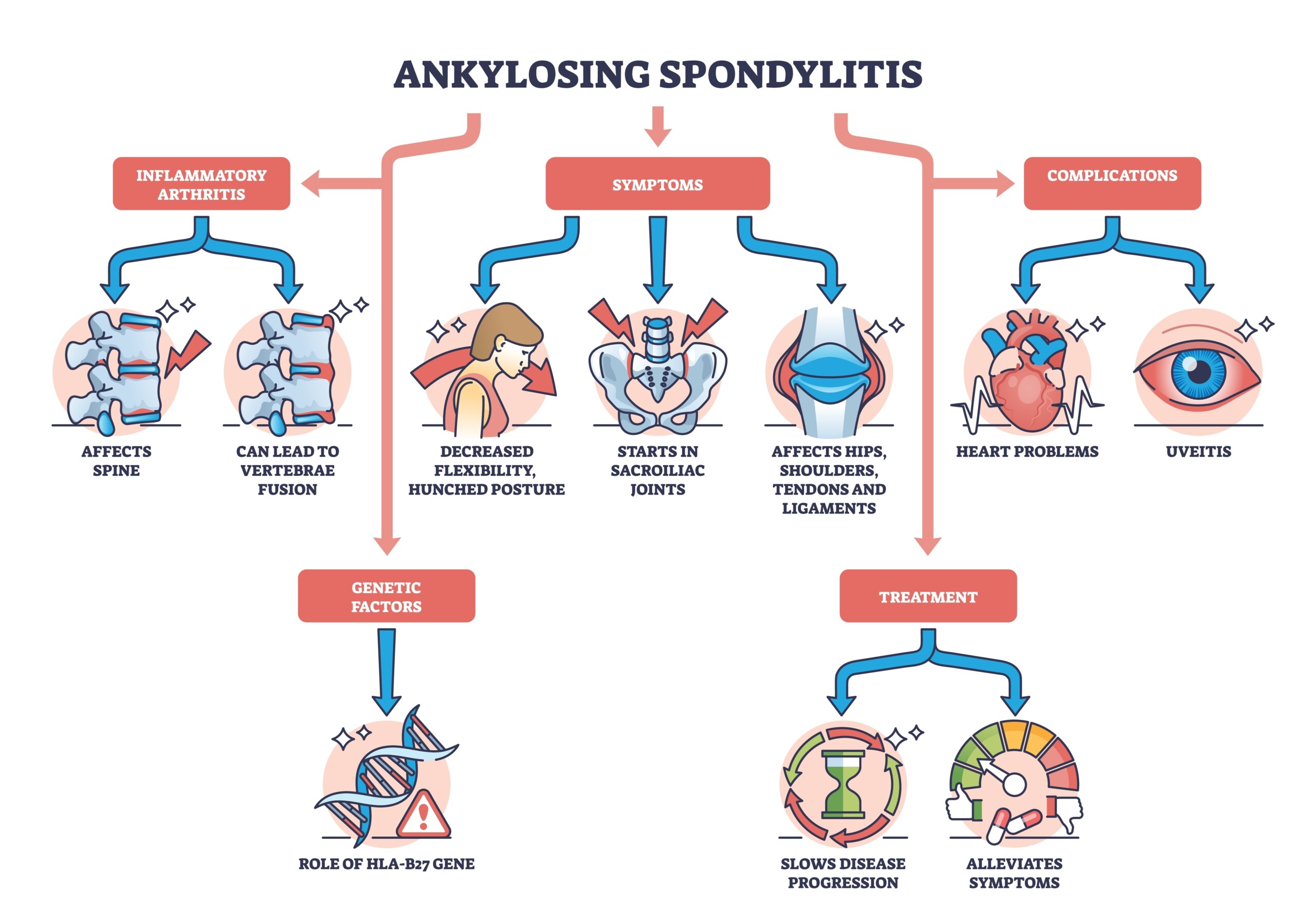
Axial spondyloarthritis is a classification that includes Ankylosing Spondylitis but also includes a similar condition that does not have the charachteristic bamboo spine presentation on X-Ray imaging. The bamboo like image is from one vertera forming bony bridges (fusing) with its adjacent vertebra along the ligaments between vertebrae, especially the outer fibres of the disc and the anterior longitudinal ligament, creating vertical lines, like bamboo. Some axial spondyloarthritis does not show bony fusion between vertebrae, hence the new umbrella term that includes both Ankylosing Spondylitis and non-radiographic axial spondyloarthritis. People with non-radiographic axial spondyloarthritis do not necessarliy progress to having bony fusion and a diagnosis of Ankylosing Spondylitis, but some do. They will, however, have signs and symptoms of inflammation in the spine and sacrioiliac joints. Short Tau Inversion Recovery (STIR)MRI can show signs of inflammation in the spine and sacroiliac joints to help with diagnosis. This type of imaging makes fluids, swelling and inflammation more easily visible when your MRI is being interpreted.
In the inital stages of developing axial spondyloarthritis, it can be difficult to diagnose. Unfortunately, it can take an average of 6-7 years go get a diagnosis in the UK. The reason for this is that the symptoms can be similar to other conditions or can be easily missed. The signs and symptoms of axial spondyloarthritis are:
- Early morning pain and stiffness that improves on getting up and moving.
- Morning stiffness that lasts more than 30 minutes.
- Movement eases the symptoms, rest makes it worse.
- Alternating buttock pain, where the symptoms move from one side to the other during different flare ups of the symptoms.
- The first symptoms start before the age of 40.
- The symptoms have lasted for at least three months without improving.
- Anti-inflammatory medication helps to moderate the symptoms.
- Occurs equally in males and femailes but Ankylosing Spondylitis occurs more in males.
- Family history of axial spondyloarthritis increases the risk that you may have it, especially if you have the HLA-B27 gene.
It is important to note, that someone with axial spondyloarthritis will likely have other inflammatory symptoms in their peripheral joints, tendons, digestive systen, and eyes. Examples include psoriosis, inflammatory bowel disease, Crohn’s disease, coeliac disease, tendinopathy (tendinitis), peripheral joint inflammation, individual swollen fingers/toes that are sausage like, and severe eye inflammation (uveitis).
Axial spondyloarthritis can be triggered by bacterial infections including salmonella in the digestive system, and sexually transmitted infections (STIs) such as chlamydia, especially in people with the HLA-B27 gene.
If you are concerned that you may hae spondyloarthritis, please see a physiotherapist or your doctor, but you can also use the Spondyloarthritis Diagnostic Evaluation Tool (SPADE tool). It is designed for health professionals to help determine if their patients may have spondyloarthritis but it is simple enough for most lay people to use. The link is: https://spadetool.co.uk/
References:
Steen E, McCrum C, Cairns M. A UK survey evaluation of First Contact Practitioners’ and musculoskeletal physiotherapists’ confidence, recognition, and referral of suspected axial spondyloarthritis. Musculoskeletal Care. 2023 Jun;21(2):380-396. doi: 10.1002/msc.1706. Epub 2022 Nov 21. PMID: 36411378.
https://www.rheumatology.org.uk/Portals/0/Documents/Policy/Rheumatology-physiotherapy-capabilities-framework.pdf?ver=2021-09-24-100925-060
https://www.nice.org.uk/guidance/ng65
